| Zone | Intensity | Heart Rate Range |
|---|
Target Heart Rate Calculator: Optimize Your Fitness Training and Health
Understanding your Target Heart Rate (THR) is a critical part of any fitness journey. Whether you’re aiming for weight loss, improving cardiovascular health, or maximizing athletic performance, knowing your optimal heart rate range can make a significant difference. This guide explores the science behind the Target Heart Rate Calculator, how to use it, and how it can help you fine-tune your exercise routine.
What is Target Heart Rate?
The Target Heart Rate (THR) is the ideal range at which your heart should beat during exercise to get the maximum cardiovascular benefit. It’s typically calculated as a percentage of your Maximal Heart Rate (MHR), which refers to the highest number of beats your heart can safely handle per minute during exercise.
Target Heart Rate Zones are essential because training within specific zones maximizes fat burning, increases endurance, or improves aerobic capacity. Understanding these zones and adjusting your intensity according to your fitness goals ensures you are training at an optimal level.
Maximal Heart Rate: The Foundation of Heart Rate Zones
Before diving into the calculation of your target heart rate, it’s essential to understand how Maximal Heart Rate (MHR) is determined. Your MHR is typically calculated based on age, but it can also be obtained through direct testing. The most commonly used formula for estimating MHR is the Haskell & Fox method:
MHR = 220 – Age
However, other formulas like Tanaka, Monahan, and Seals (2001) or Nes et al. (2013) may provide more accurate results for different age groups and fitness levels. Let’s take a closer look at these formulas:
- Haskell & Fox (1971):
MHR = 220 - Age - Tanaka et al. (2001):
MHR = 208 - 0.7 × Age - Nes et al. (2013):
MHR = 211 - 0.64 × Age
The choice of formula can be influenced by factors such as your age and general health condition. For older adults, the Tanaka formula may provide a more accurate estimate.
Target Heart Rate Zones: Understanding Exercise Intensity
To determine the optimal heart rate for your training, it’s important to know the different Heart Rate Zones. These zones are defined as percentages of your MHR and vary based on your fitness goals:
- Zone 1 (50-60% MHR) – Very light: Ideal for beginners and warm-ups.
- Zone 2 (60-70% MHR) – Light: Suitable for endurance training.
- Zone 3 (70-80% MHR) – Moderate: Targets aerobic fitness and improves cardiovascular health.
- Zone 4 (80-90% MHR) – Hard: Enhances athletic performance and speed.
- Zone 5 (90-100% MHR) – Maximum: Used for short bursts of high-intensity interval training (HIIT).
Karvonen Formula: A more advanced method of calculating Target Heart Rate is the Karvonen Formula, which factors in Resting Heart Rate (RHR) to give a more personalized heart rate zone. This method is especially beneficial for individuals with lower resting heart rates or those with specific training goals. The Karvonen formula works as follows:
Target HR = ((MHR – RHR) × intensity) + RHR
Where RHR is your resting heart rate, measured when you’re at complete rest, usually first thing in the morning before getting out of bed.
How the Target Heart Rate Calculator Works
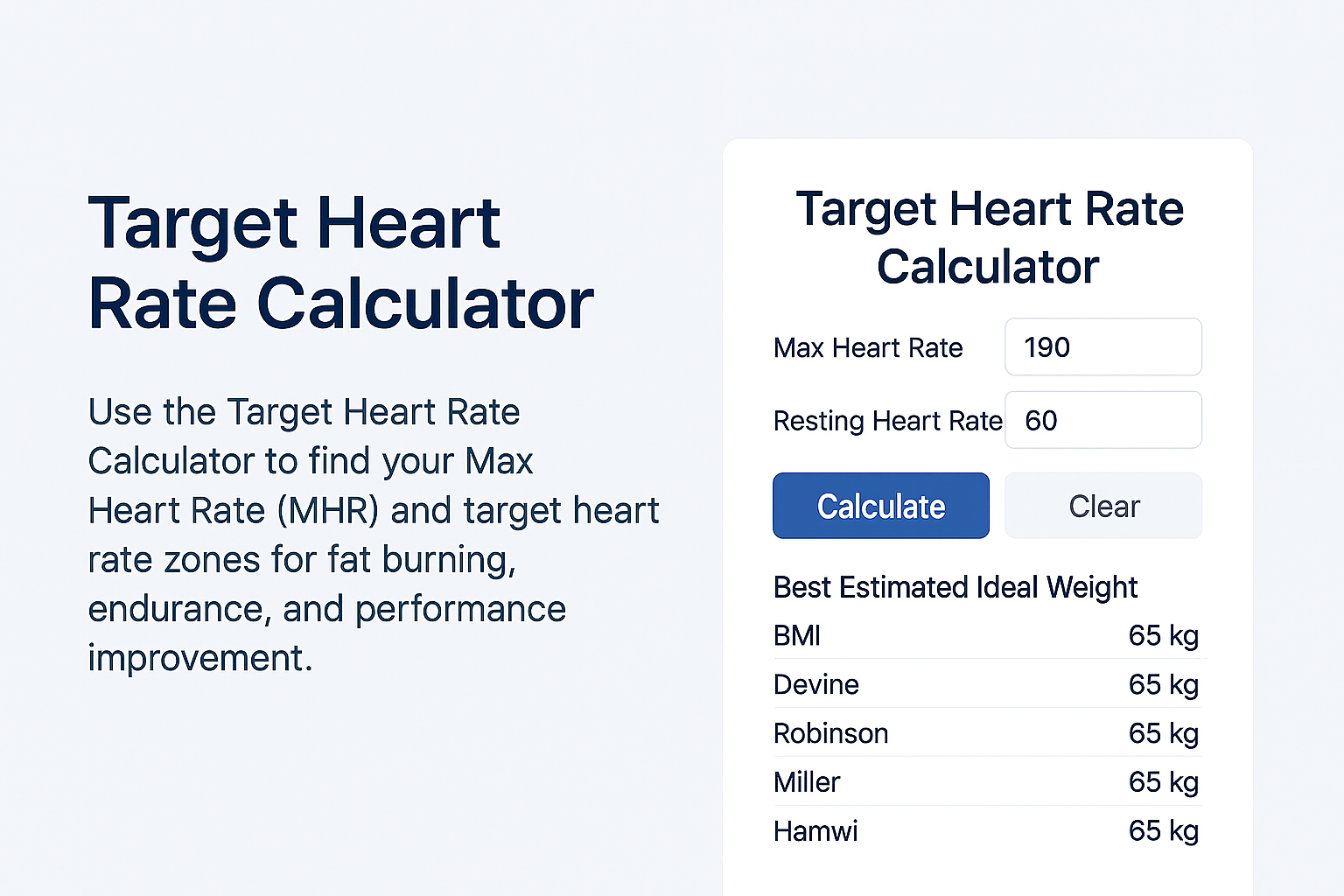
Our Target Heart Rate Calculator simplifies the process of determining your optimal training zones. By inputting your age, resting heart rate (optional), and selecting your preferred formula and calculation method, the calculator will estimate your Max Heart Rate (MHR) and then calculate your Target Heart Rate Zones.
Key Features of the Target Heart Rate Calculator:
- Max Heart Rate Calculation: Estimate MHR using the Haskell, Tanaka, or Nes formula.
- Custom Input: Option to input your actual Max Heart Rate for a more accurate result.
- Activity Intensity Options: Choose between the Karvonen formula (for personalized heart rate reserve) or the standard percentage method.
- Multiple Heart Rate Zones: View your heart rate zones with calculated ranges in a convenient table format, showing low and high values for each zone.
Why Knowing Your Target Heart Rate is Important
Training within your target heart rate zone provides a more efficient workout. Here are some reasons why you should pay attention to your Target Heart Rate during exercise:
- Fat Burning: Training in the lower zones (50-60% MHR) is most effective for burning fat.
- Endurance: Moderate intensity (60-70% MHR) helps build stamina for longer workouts.
- Cardiovascular Health: Higher intensity (70-80% MHR) improves heart health and aerobic fitness.
- Performance Improvement: Training at higher intensities (80-90% MHR) enhances athletic speed and power.
- Personalization: Using the Karvonen Formula, you can tailor your heart rate zones by factoring in your resting heart rate for more accurate zones.
How to Use the Target Heart Rate Calculator
Using the Target Heart Rate Calculator is simple. Follow these steps to get your heart rate zones:
- Step 1: Choose whether you want to estimate your Max Heart Rate based on age or enter a custom value from a test result.
- Step 2: Input your age if you’re using the age-based estimate.
- Step 3: Provide your resting heart rate (optional but highly recommended for accuracy).
- Step 4: Choose the heart rate estimation formula (Haskell, Tanaka, or Nes).
- Step 5: Choose your activity intensity scale (Standard or Karvonen).
- Step 6: Press the Calculate button to view your Target Heart Rate Zones.
The calculator will display your Max Heart Rate, Resting Heart Rate, and the Heart Rate Zones in a table. Each zone will have its corresponding intensity percentage, as well as the specific heart rate range you should aim for in each zone.
FAQ: Target Heart Rate Calculator
1. What is a Target Heart Rate?
A Target Heart Rate (THR) is the ideal range at which your heart should beat during exercise to gain the maximum cardiovascular benefit. Training within this zone optimizes fat burning, improves endurance, and helps build aerobic fitness. It’s calculated as a percentage of your Maximal Heart Rate (MHR).
2. How do I calculate my Max Heart Rate (MHR)?
Your Max Heart Rate (MHR) is the highest number of times your heart should beat per minute during intense physical activity. You can estimate it based on your age using the following formulas:
Haskell & Fox:
MHR = 220 - AgeTanaka et al.:
MHR = 208 - (0.7 × Age)Nes et al.:
MHR = 211 - (0.64 × Age)
Alternatively, you can input your actual Max Heart Rate from a stress test or other methods for more accuracy.
3. Why is my Resting Heart Rate (RHR) important?
Your Resting Heart Rate (RHR) is your heart rate when you’re at rest. It reflects the efficiency of your heart and cardiovascular system. A lower RHR generally indicates better cardiovascular fitness. It’s particularly useful for more personalized calculations of Target Heart Rate Zones using the Karvonen Formula, which factors in your RHR to provide more accurate intensity ranges.
4. What are Heart Rate Zones, and why are they important?
Heart Rate Zones are ranges of heart rates expressed as a percentage of your Max Heart Rate (MHR). They help you target specific fitness goals:
- Zone 1 (50-60%): Very light, ideal for warm-ups and recovery.
- Zone 2 (60-70%): Light, improves endurance and fat-burning.
- Zone 3 (70-80%): Moderate, increases aerobic fitness and endurance.
- Zone 4 (80-90%): Hard, boosts performance and anaerobic capacity.
- Zone 5 (90-100%): Maximum, used for short bursts of high-intensity interval training (HIIT).
Each zone is designed to target different aspects of your fitness, from fat burning to improving cardiovascular health.
5. What’s the difference between the Karvonen Formula and the Standard Method?
Standard Method calculates the Target Heart Rate as a percentage of your Max Heart Rate (MHR), with no consideration for your Resting Heart Rate (RHR).
Karvonen Formula adjusts the target range based on your Resting Heart Rate (RHR), providing a more personalized and accurate calculation. It’s particularly useful for those who have a lower RHR or are training at a specific intensity level.
6. Can I use the Target Heart Rate Calculator without entering my Resting Heart Rate?
Yes, you can still use the calculator by choosing the Standard Method, which doesn’t require your Resting Heart Rate. However, for more personalized and accurate results, it’s recommended to input your RHR, especially if you plan to use the Karvonen Formula.
7. How do I use the Target Heart Rate Calculator?
To use the Target Heart Rate Calculator, follow these steps:
- Choose your calculation method: Select whether you want to estimate your Max Heart Rate based on age or input a custom Max Heart Rate from a test.
- Enter your age if using the age-based estimate.
- Enter your Resting Heart Rate (optional) for personalized calculations.
- Choose your heart rate estimation formula (Haskell, Tanaka, or Nes).
- Choose your activity intensity scale: either the Karvonen formula (for more personalized results) or the standard percentage method.
- Click “Calculate” to view your Target Heart Rate Zones.
8. Why should I calculate my Target Heart Rate before working out?
Knowing your Target Heart Rate allows you to train at the appropriate intensity for your fitness goals. Whether you’re aiming for fat loss, improving endurance, or boosting athletic performance, training within your target zone maximizes your efforts and prevents overtraining or undertraining.
9. Can the calculator work on mobile devices?
Yes, the Target Heart Rate Calculator is fully responsive and can be used on smartphones and tablets. It will adjust the layout to fit smaller screens, providing the same functionality on all devices.
10. How do I clear the calculator and start over?
You can reset the calculator by clicking the “Clear” button, which will remove all the input fields and display the results section as hidden.
11. What if I don’t know my Max Heart Rate or Resting Heart Rate?
If you don’t know your exact Max Heart Rate (MHR) or Resting Heart Rate (RHR), you can estimate your MHR using the age-based formulas, and leave your Resting Heart Rate blank or use the default value.
12. Can the calculator be used for specific fitness goals like weight loss or endurance training?
Yes! Based on your desired fitness goals, the Target Heart Rate Calculator helps you select the most appropriate heart rate zone for your exercise. For fat loss, staying in Zone 2 is ideal, while Zone 4 is better for improving performance and endurance.
13. Can I adjust the settings for more accurate calculations?
Yes, the Target Heart Rate Calculator has advanced settings for adjusting the formula type (Haskell, Tanaka, or Nes) and the activity intensity scale (Karvonen or Standard). These settings allow for more accurate, personalized results based on your unique health profile and fitness level.
14. What is the significance of each heart rate zone?
Each zone represents a different level of exercise intensity, and each has specific benefits:
- Zone 1: Ideal for warming up or recovery.
- Zone 2: Best for improving endurance and fat burning.
- Zone 3: Builds cardiovascular fitness.
- Zone 4: Improves athletic performance.
- Zone 5: Boosts maximum speed and power.
- By training in different zones, you can target specific fitness objectives and get the most out of your workouts.
15. How do I know if I’m training in the correct zone?
You can monitor your heart rate using a fitness tracker or heart rate monitor to ensure you’re staying within your Target Heart Rate Zone during exercise. Many modern fitness devices come with built-in heart rate tracking.
Conclusion: Maximize Your Training with the Target Heart Rate Calculator
The Target Heart Rate Calculator is a powerful tool for anyone looking to optimize their fitness training. Whether you’re a beginner or an experienced athlete, understanding your heart rate zones will help you train more effectively and reach your fitness goals faster. By utilizing the appropriate heart rate zones, you can improve fat burning, endurance, cardiovascular health, and overall fitness.
Use this calculator to take control of your workout intensity, make smarter decisions about your fitness routine, and achieve your health goals with precision.
Search Keywords
Target Heart Rate, Max Heart Rate, MHR, Karvonen Formula, Heart Rate Zones, Exercise Intensity, Fitness Training, Cardiovascular Health, Endurance Training, Fat Burning, Heart Rate Reserve, Fitness Calculator, Resting Heart Rate, Workout Intensity, Tanaka Formula, Haskell Formula, Fitness Goals, Aerobic Capacity, Personalized Heart Rate Zones, Physical Fitness, Heart Rate Calculator, Target HR, Exercise Zones, Health Tracking, Athletic Performance.
Our Other Online Calculators
You Can Also Check Out Our Other Free Online Tools Like Age Calculator, Percentage Calculator, Body Fat Calculator, And More.”
Are You Searching For A Government Job In India
You Can Also Check Our Job Alert, Admit Card, And Sarkari Result Updates On ExamJobAlert.com – Your Trusted Source For Government Job Notifications.